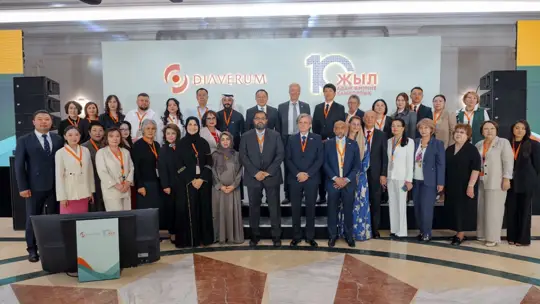
Diaverum marked 10 years of operations in Kazakhstan, recognising a decade of expanding access to high-quality, patient-centred renal care across the country. Since entering Kazakhstan in 2015 with nine clinics, Diaverum has grown into a network of 55 clinics across 16 regions, serving more than 3,400 patients and employing over 1,000 local healthcare professionals and support staff.
The anniversary brought together representatives from Kazakhstan’s healthcare authorities and government bodies, alongside the Ambassador of Sweden to Kazakhstan and the Counsellor of the UAE Embassy, as well as healthcare leaders, partners and employees. Their participation reflected the importance of long-term collaboration in strengthening access, quality and resilience across Kazakhstan’s healthcare system.
Extending access across Kazakhstan
Chronic kidney disease requires reliable access to life-sustaining treatment, including beyond major urban centres. While approximately 90% of dialysis treatments in Kazakhstan are delivered by the private sector, Diaverum cares for around 30% of the country’s dialysis population. Its network spans major cities including Astana, Almaty, Karagandy, Aktobe, Oral, Shymkent and Kostanay, as well as smaller and remote communities where supply, logistics and operating costs are higher. This nationwide presence helps patients receive essential treatment closer to home.
Amantur Ryskulov, Regional General Manager for South East Asia and Central and East Asia, said: “Our first decade in Kazakhstan has been defined by the trust of our patients, the commitment of our colleagues and close cooperation with healthcare authorities and partners. Our growth has never been about scale alone. It has been about bringing reliable, high-quality care closer to people, including in communities where access is more challenging, and helping patients live fuller and more fulfilling lives.”
Quality and innovation at scale
Diaverum Kazakhstan’s network holds the country’s highest national healthcare accreditation rating, “Excellent”, renewed in 2025. Its clinics are also benchmarked against Diaverum’s international clinical standards through monthly monitoring of key dialysis performance indicators, supporting consistent quality, patient safety and continuous improvement.
Kazakhstan is also home to the first digital dialysis clinic in the country and Central Asia. Connected with Kazakhstan’s public e-health infrastructure, Diaverum’s digital capabilities help clinical teams deliver safer, more coordinated and efficient care while keeping the relationship between patients and caregivers at the centre. The organisation further supports local capability building through d.ACADEMY, its internationally recognised learning platform for doctors and nurses.
Local impact supported by global expertise
The Kazakhstan milestone coincides with Diaverum’s 35th anniversary globally. From its first clinic in Sweden, Diaverum has developed a connected international renal care network with expertise spanning prevention, haemodialysis, home care, vascular access and transplantation coordination. In Kazakhstan, that expertise is adapted to local priorities through partnership with healthcare stakeholders and continued investment in people, infrastructure and digital care.
As part of M42, a global health leader powered by AI and technology, Diaverum is positioned to build on this foundation by combining clinical expertise, digital infrastructure and data-driven insights to improve outcomes and patient experience.
Ziyad Kabli, Chief Operating Officer, Middle East and Asia, M42, said: “Kazakhstan demonstrates what sustained local partnership and internationally benchmarked care can achieve. As Diaverum enters its next decade in the country, our focus is on building on that strong foundation using clinical expertise, technology and data to make renal care more connected, personalised and accessible, while contributing to a stronger and more sustainable healthcare system.”
Diaverum Kazakhstan will continue to strengthen clinical outcomes, expand access and explore integrated and digitally enabled models of care. The organisation’s experience in Kazakhstan also provides a strong platform for the continued development of renal care across Central Asia, grounded in the local partnerships, people and communities that have shaped its first decade.