Chronic kidney disease (CKD) is not lived in isolated medical moments. It reshapes daily life - energy, mobility, independence, work, family rhythms. Dialysis sustains life, but it cannot restore everything that chronic illness takes. True renal care must therefore go beyond treatment. It must protect quality of life through prevention, early intervention and practical support - because the hardest parts of CKD are often not clinical. They are personal.
We often speak about “walking in a patient’s shoes”. For Magali Bourgeois, podiatrist at Diaverum France, that idea is not a metaphor, it is lived experience. And through her work, she has taken it one step further.
I have been a chiropodist–podiatrist since 1999. Foot health has always been my field - prevention, vigilance, attention to small signs that can become serious if ignored. I have also known what it is to live with chronic kidney disease. I am currently undergoing dialysis three times a week in a Diaverum clinic while waiting for my fourth kidney transplant.
Living with CKD changes how you understand the body. It makes you aware of vulnerability - not in theory, but in practice. You feel what it means to depend on treatment, on systems, on people. That experience has shaped how I see my profession, and why it is my profound belief that true healthcare must, and should always be holistic.
When you work in dialysis, you quickly understand that the feet tell a story. Many patients live with diabetes, vascular disease or neuropathy. Circulation can be compromised. Sensation can be reduced. Healing can be slower. A small cut or blister may go unnoticed. What begins as something minor can become an ulcer. An ulcer can become an infection. And infection, in this population, can escalate quickly. And when mobility decreases because of pain or wounds, the world becomes even smaller and more restricted for people whose lives are already shaped by a chronic illness.
And yet, podiatry is often not easy to access. It can mean another appointment, another journey, another demand on an already exhausting schedule. Patients are tired. Treatment is demanding. Time is limited.
Over time, I saw how often preventative foot care was delayed - not because patients didn’t understand its importance, but because their lives were already stretched. The solution was simple.
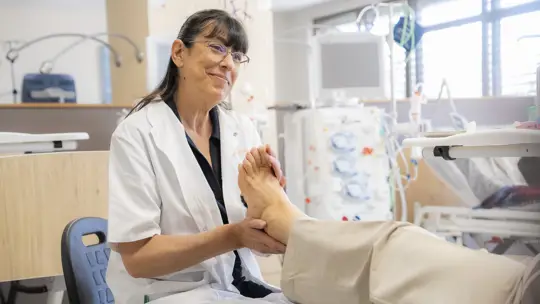
If patients are already here for dialysis several times a week, why not bring podiatry care to them? Why not integrate it into the time they are already dedicating to treatment?
With the support of the Diaverum Provence team, we developed a model that allows podiatry consultations to take place during dialysis sessions. Patients did not need to travel elsewhere. We optimised time already spent in clinic. Most importantly, we strengthened prevention - identifying risks early, reducing complications, and protecting mobility. This initiative was not about innovation for its own sake. It was about practicality. It was about acknowledging that chronic illness is demanding - and that if we can remove even one barrier, we should.
That, for me, is what True care really is; it is not soft, nor decorative. It is steady. It is preventative. It is practical. It is staying close to our patients through the hardest, sometimes unseen parts of chronic illness – and responding to their needs, beyond dialysis alone.
Receiving the 2025 True care Award was a recognition I never expected. To know that colleagues from different countries and functions from across the world chose this initiative among so many meaningful nominations is something I don’t take lightly. What it reminds me, is that True care is not something we claim at Diaverum; it’s something we recognise in one another, because it is something we all carry in our work, in a myriad ways.
Has this story inspired you to join Diaverum? Visit our Careers website and discover openings across the world.